
the protection of HUMAN DEVELOPMENT INFRASTRUCTURE
The governing moat - five Walls of operational protection
Five integrated components that protect public safety outcomes from fragmentation, political turnover, and implementation erosion — regardless of administration, budget cycle, or scale.
The MOAT WALL MAP
Infrastructure That Protects Operations, Fidelity, And Outcomes.
SCES is built on five infrastructure components. Together they form the Governing Moat — the layered architecture that holds regardless of administration, budget cycle, or scale. Every city that licenses SCES licenses uncompromised strength.
HUMAN DEVELOPMENT DOCTRINE
The single non-negotiable standard governing what capacities must be built — emotional regulation, decision-making, accountability, and economic competence — as the shared operational language across every connected institution.
EDUCATION & TRAINING DEPARTMENT
Institution-grade education infrastructure delivering mandatory core curriculum, sequenced elective advancement, and performance-based readiness standards that produce capacities enforcement cannot generate.
UNIFIED COMMUNITY DATA SYSTEM (UCDS)
The governed evaluation architecture maintaining each participant's developmental record across every institutional transition with role-based, auditable cross-agency data access.
Uncompromised
Strength
No component functions in isolation. No component is optional. The moat is only a moat when all five walls stand.
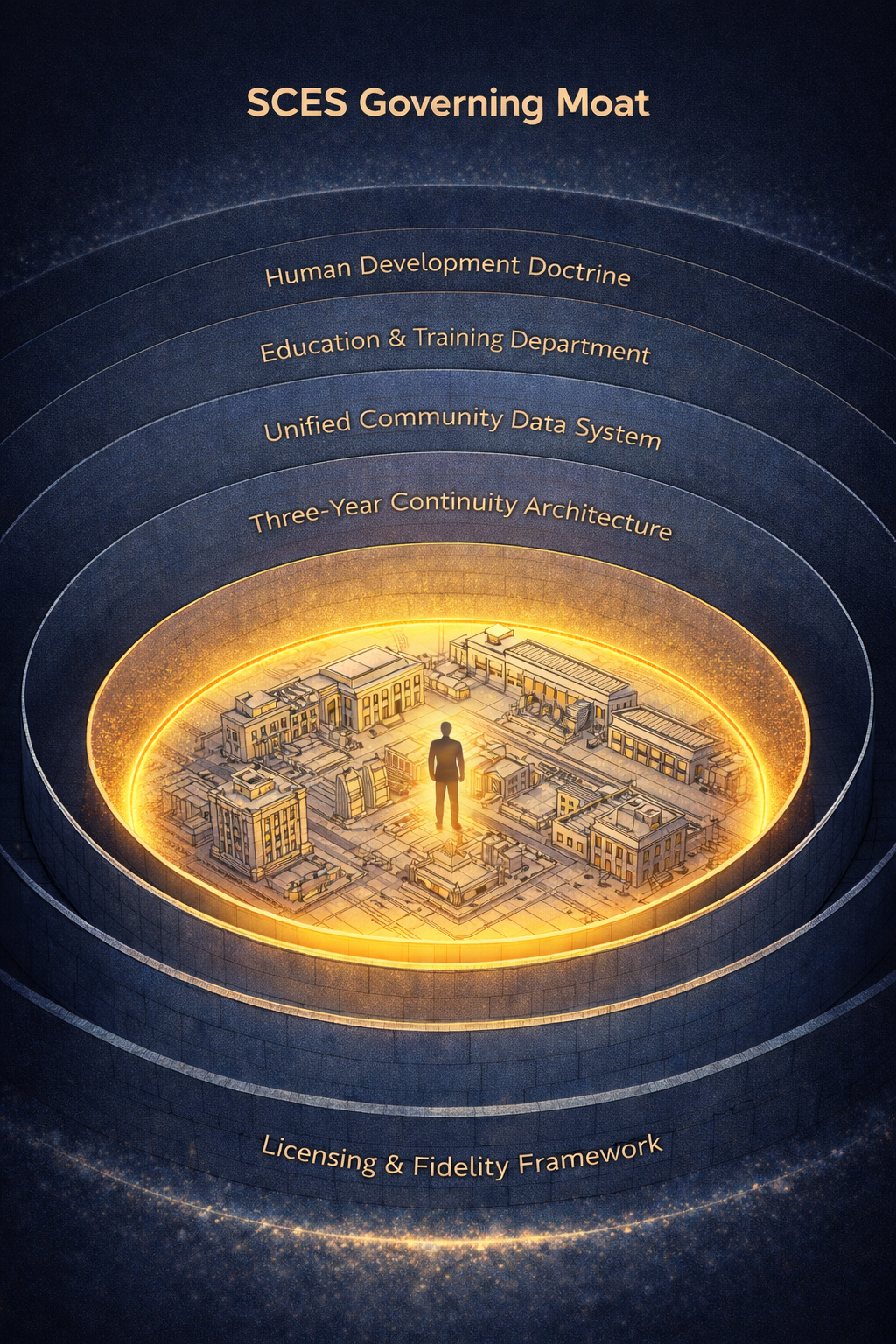
THREE-YEAR CONTINUITY ARCHITECTURE
Structured post-completion access keeping participants connected to coaching, curriculum, and advancement programming during the three-year window when regression risk is highest.
LICENSING & FIDELITY FRAMEWORK
The legal and governance mechanism that protects intellectual property, ensures fidelity across all partner agencies, and keeps SCES intact across administrations and budget cycles.
THE RESULT
Durable, scalable, auditable, cost-avoidance architecture that allows cities to observe performance, adjust policy alignment, and demonstrate measurable value and outcomes without operational disruption.
The operational differentiator
Every city already runs agencies, programs, and intervention services. None of them contain a structured Education & Training Department. That absence is not an oversight — it is the architectural gap that allows fragmentation to return every time a new administration arrives, a budget shifts, or a reform initiative loses momentum.
SCES was built to close that gap permanently. The Education & Training Department inside of SCES is not a feature. It is the defining wall of the moat.
C-1
Education & Training Department
The doctrine and curriculum that cannot be informally replaced or politically dismantled.
C-2
Participant Continuity Corridor
The five-stage pathway that sequences progress across administrations, not within them.
C-3
IEP & Progression Gates
The performance instrument that makes advancement evidential and defensible under audit
C-4
Coaching & Clinical Infrastructure
The human layer that sustains developmental continuity when institutions change.
C-5
Risk-Tiered Pathways
The calibration architecture that keeps the system governing at every population level.
What the Education & Training Department Is
The SCES Education and Training Department is not a workshop series, a curriculum vendor, or a case management add-on. It is an institution-grade education infrastructure — operating inside city government authority — that delivers mandatory core curriculum, earned elective advancement, and rigorous readiness standards to the individuals who cycle through public safety and crisis systems.
In SCES, education is not supplemental. It is public safety infrastructure. It produces the internal capacities — emotional regulation, consequential decision-making, behavioral accountability, economic competence — that enforcement cannot generate and services cannot sustain without a developmental foundation beneath them.
Curriculum Structure & Human Development Doctrine
The Education & Training Department operates from a single, non-negotiable human development doctrine: what capacities must be built for an individual to maintain lawful stability under stress. That doctrine governs every course, every coaching interaction, and every advancement decision across every agency and provider connected to SCES. It is not a preference. It is the common language that prevents the conflicting frameworks, duplicated assessments, and competing standards that currently make cross-agency coordination functionally impossible.
mandatory core
Emotional regulation, consequential thinking, behavioral accountability, stress response
Why it is non-negotiable
These are the capacities that most directly predict whether an individual re-enters crisis systems. They are not optional curriculum — they are the developmental prerequisite for everything else in the pathway.
earned electives
Employment readiness, financial literacy, community leadership, advanced skill development
why it is non-negotiable
Elective access is earned through demonstrated progress in core curriculum. Advancement is not time-based — it is capacity-based. This preserves the integrity of the progression gate.
economic competence
Workforce attachment, financial decision-making, income stability, economic independence
why it is non-negotiable
Workforce disruption is one of the highest-cost long-term outcomes of developmental discontinuity. Economic competence training is embedded — not an afterthought — because employment stability is a public safety outcome.
The E&T Department initiates the participant corridor. See how the five stages sequence development from entry to sustained independence. →
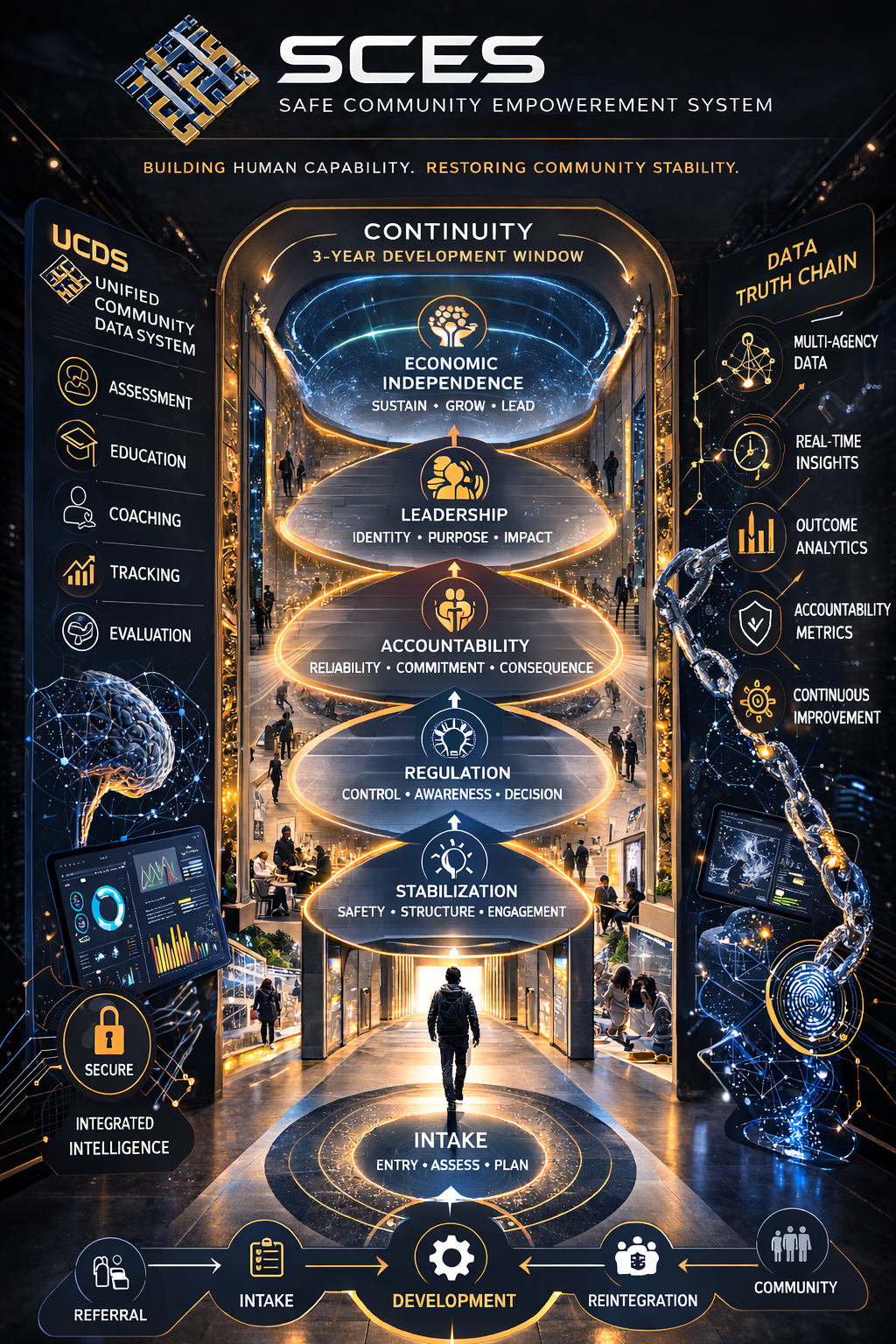
The Five Corridor Stages
What the Corridor Is
The Participants Corridor is the developmental pathway an individual moves through inside SCES — from initial entry to sustained independence.
It is not a treatment timeline or a compliance calendar. Each stage is defined by demonstrated capacity, not elapsed time. An individual advances when they have earned the next stage, not when an administrative clock has run.
The corridor functions as the connective architecture between the Education & Training, Performance Coaching infrastructure, the Data System, and the Three-Year Continuity Reality baseline.
It is what allows progress achieved in one institution to continue in the next, rather than resetting at every handoff.
city scale
How Education & Training Deploys
Across the 5 Corridor Stages
New York City
large Jurisdiction at scale
NYC deploys the Education & Training as a cross-agency education infrastructure spanning Correction, Probation, and CVI partners. The shared doctrine eliminates the competing frameworks that currently produce conflicting requirements for the same individuals.
Personnel across all participating agencies train and certify to the same standard before the first participant is enrolled.
Albany, NY
jurisdiction at municipal scale
Albany implements the Education & Training through a smaller agency footprint with faster time-to-activation.
The Albany corridor integrates city supervision, county probation, and designated community providers under one educational standard — producing the same developmental outcomes without the coordination overhead that larger jurisdictions require.
The Education & Training Department initiates the participant corridor. See how the five stages sequence development from entry to sustained independence. →
Stage 01
Intake & Orientation
The individual enters the corridor through a formal referral pathway connected to city authority. Baseline developmental assessment is conducted. Individual Empowerment Plan established. Doctrine, expectations, and advancement criteria explained clearly before any curriculum begins. No participant enters the corridor without a defined starting point and a visible pathway forward.
NYC Intake & Orientation operates across multiple referral sources — Correction, Probation, MOCJ partners, and CVI programs — channeled through a unified intake protocol. Baseline assessment is consistent regardless of referral origin.
Albany Intake & Orientation is conducted through a tighter referral network — city supervision, county probation, and designated community partners — allowing faster orientation and IEP establishment in the first corridor activation.
Stage 02
Core Development
The individual engages mandatory core curriculum in the E&T Department. Emotional regulation, consequential decision-making, behavioral accountability, and economic competence are the foundational capacities built in this stage. Advancement to Stage 3 requires demonstrated performance sustained over time — not completion of a course, not attendance. Demonstrated capacity.
NYC Core Development operates across facility and community settings, with coaches embedded to sustain doctrine consistency as individuals move between environments. Performance is tracked continuously in the UCDS.
Albany Core Development concentrates in community-based settings aligned with city supervision. Smaller cohort sizes allow more intensive coaching contact during the foundational stage — which accelerates demonstrated capacity relative to larger implementations.
Stage 03
Stabilization
The individual has demonstrated core capacities and begins applying them in higher-stakes environments — employment preparation, community accountability, expanded autonomy. Coaching intensity is recalibrated rather than reduced. Clinical touchpoints remain active. Earned elective curriculum opens. This stage is where prior investment either compounds or collapses — SCES maintains continuity deliberately through this transition.
NYC Stabilization coordinates across supervision, employment, and housing systems. The UCDS ensures that progress recorded in one system is visible across all — preventing the reset that typically occurs when an individual transfers between agency oversight.
Albany Stabilization is where the corridor's cross-agency architecture produces its most visible impact. Progress tracked in city supervision is available to county probation, employment partners, and housing providers — eliminating the re-assessment cycle that current Albany systems require.
Stage 04
Advancement
The individual demonstrates sustained behavioral reliability and is placed into employment, advanced education, or community leadership pathways based on earned readiness — not slot availability, not administrative timeline. Referrals from SCES to employment and education partners are readiness-based. Partners receive prepared individuals. Placement success rates reflect preparation quality, not referral volume.
NYC Advancement connects to a wide employment and education partner network. SCES's prepared referral infrastructure reduces placement failure rates and protects provider performance metrics — which is a direct value argument for every CBO and workforce partner in the city's ecosystem.
Albany Advancement focuses on local employment attachment and workforce readiness within Albany's economic footprint. The prepared referral model protects Albany's smaller provider community from the churn that underprepared referrals consistently produce.
Stage 05
Continuity & Independence
Completion of core requirements does not end access. Individuals remain eligible for coaching support, elective advancement, and evaluation continuity during the three-year period when regression risk is highest. Support reduces in intensity — it does not disappear. This stage protects the public investment made in Stages 1 through 4 and is the primary mechanism through which SCES reduces long-term recidivism and system re-entry costs.
NYC Continuity operates at scale across a population with the highest absolute volume of three-year regression risk. The continuity architecture produces its greatest fiscal return here — reducing the repeat utilization that drives the highest-cost items in Correction, Probation, and H+H budgets.
Albany Continuity produces measurable impact within a smaller population — but the proportional fiscal return is comparable. Reduced re-entry events, lower supervision intensity requirements, and workforce attachment stability translate directly into Albany's public safety and human services budget lines.
How does progress get measured at each stage? See Individual Empowerment Plans and Progression Gates. →
INDIVIDUAL EMPOWERMENT PLANS
The Accountability Instrument
Every individual in SCES operates under an Individual Empowerment Plan (IEP). The IEP is not a case file, a service plan, or a compliance document. It is a performance instrument — a structured record of developmental goals, curriculum progression, coaching milestones, and advancement criteria that is active, updated, and evaluated continuously across every stage of the corridor.
The IEP is what makes cross-agency continuity operational rather than aspirational. When an individual moves from city supervision to county probation to a workforce program, the IEP moves with them. The receiving institution does not restart the assessment. It continues from a verified developmental baseline.
Developmental Baseline
Initial assessment of core capacities at intake. Establishes the starting point for all progression measurement. Cannot be skipped or substituted with prior program records.
Goal Architecture
Structured developmental goals tied directly to corridor stage requirements. Goals are specific, measurable, and connected to advancement criteria — not aspirational statements.
Curriculum Sequence
The ordered progression of mandatory core curriculum and earned electives assigned to this individual based on baseline assessment and risk tier. Sequence adjusts as capacity is demonstrated.
Coaching Milestones
Defined checkpoints at which coaching interaction, real-world performance, and behavioral reliability are evaluated. Milestones are not attendance markers — they are demonstrated performance thresholds.
Progression Gate Record
The documented decision at each stage transition: what was demonstrated, who verified it, and when advancement was authorized. This is the audit trail that makes every advancement decision defensible.
Progression Gates - What They Are and Why They Exist
A progression gate is the formal evaluation point between corridor stages. Advancement does not occur automatically. It requires demonstrated capacity sustained over time, verified by coaching staff, documented in the IEP, and recorded in the UCDS. Gates exist because the alternative — time-based advancement — is what most existing systems already do, and it is why most existing systems produce compliance without development.
Who verifies the IEP milestones and coaches real-world performance? See Performance Coaching and Clinical Touchpoints. →
Performance Coaching & Clinical Touch-Points
Performance coaching in SCES is not therapy. It is not supervision. It is the human infrastructure that translates what the E&T Department teaches into what the individual actually does under pressure — and monitors whether that translation is holding.
Coaching is development enforcement, not behavioral enforcement.
SCES performance coaches are assigned to individuals throughout the corridor. Their function is specific: translate curriculum learning into real-world execution, monitor developmental trajectories using UCDS indicators, intervene early when risk indicators rise, and sustain accountability through structured relationship rather than punitive escalation. Coaches do not supervise. They develop. The distinction matters operationally because supervision triggers compliance — and compliance without capacity is the condition that produces technical violations, re-entry, and system churn at cost.
Clinical Touchpoints - What They Are and What They Are Not
Embedded Mental Health Professionals operate at defined touchpoints throughout the corridor — not as open-ended therapists, not as crisis responders, and not as gatekeepers to program access. Their role is narrow and deliberate: stabilize acute issues that would interrupt developmental progress, strengthen the emotional regulation work being done in the E&T curriculum, and prevent clinical need from becoming the reason an individual exits the corridor prematurely.
SCES does not turn public safety infrastructure into a mental health program. Clinical touchpoints are positioned to support capacity-building — not replace it. The coaching infrastructure is primary. Clinical support is embedded. The distinction is non-negotiable because conflating the two is what transforms development-focused systems into open-ended dependency.
How does SCES calibrate intensity for higher-risk versus lower-risk participants without changing doctrine? See Risk-Tiered Pathways. →
SERVING ALL POPULATIONS UNDER CITY SERVICES
The Architectural Principle: Risk Tier Framework
One System, Calibrated Intensity.
SCES operates across varying risk levels, justice statuses, age groups, and co-occurring challenges without lowering standards or fragmenting into separate models. This is not achieved by simplifying the system.
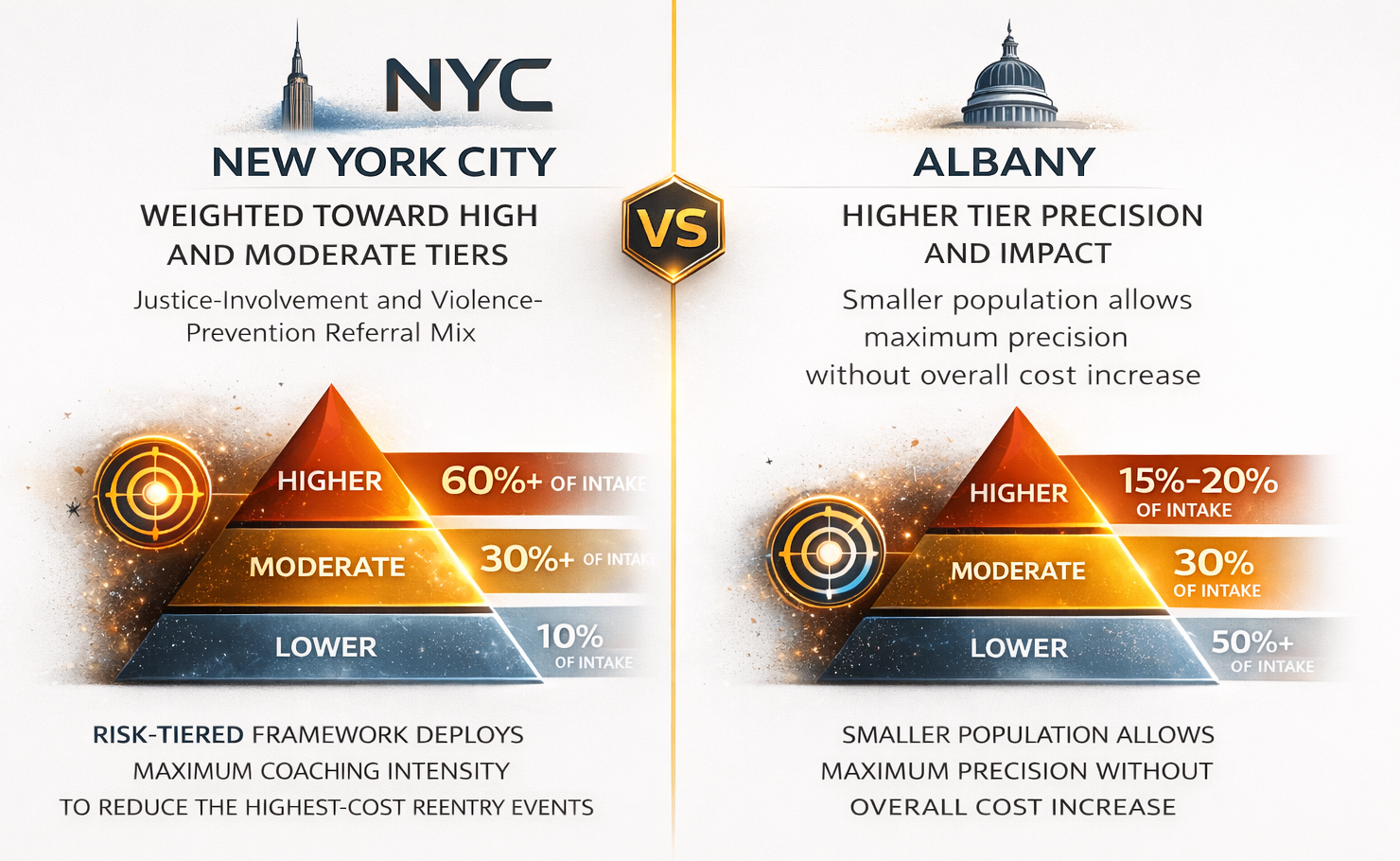
It is achieved by separating doctrine from intensity. The human development doctrine — what capacities must be built — is constant. The intensity with which the system delivers that doctrine is calibrated to each individual's demonstrated risk and developmental need.
This design prevents the two most common failures of multi-population systems: over-supervising individuals whoare already stabilizing, which produces resentment and disengagement, and under-supporting individuals who require structured development to avoid returning to crisis conditions, which produces re-entry and cost.
High Intensity
Maximum Structure
Population
Justice-involved with active supervision, recent incarceration, high behavioral risk indicators
Supervision
Daily coach contact, mandatory clinical touchpoints, restricted elective access until Stage 3
Pathway
Full core curriculum before any advancement. Gate verification requires all observers.
Moderate Intensity
Standard Structure
Population
Diversion-enrolled, probation-supervised, violence-prevention referrals with moderate risk indicators
Supervision
Weekly coach contact, scheduled clinical touchpoints, elective access begins at Stage 2 with gate approval
Pathway
Standard corridor progression. Gate verification requires coach and instructor confirmation.
Low Intensity
Calibrated Autonomy
Population
Reentry with demonstrated prior stability, youth early-intervention, workforce-ready referrals
Supervision
Bi-weekly coach contact, clinical touchpoints available on request, full elective access from Stage 2
Pathway
Accelerated advancement permitted where capacity is demonstrated ahead of timeline.
Doctrine Consistency - What Never Changes Regardless of Tier
Risk tier determines the intensity of coaching contact, the pace of progression, and the level of supervision structure. It does not change the developmental doctrine, the curriculum standards, the IEP requirement, the progression gate criteria, or the three-year continuity architecture. Every individual in every tier advances through the same five corridor stages, earns the same readiness gates, and receives the same post-completion continuity access. The system is equitable because the standard is constant. The support is calibrated because the need is not.
Request A Briefing
Have seen enough to know whether SCES belongs in front of your leadership team?
The next step is a 30-minute briefing — structured for mayors, city managers, and agency directors. It covers what SCES delivers in Year 1, how it integrates with your existing authority structure, and what New York City and Albany represent as proof of scale range.
This is a peer conversation, not a sales call. If it is not the right fit for your city, that answer comes out in the first ten minutes.
No newsletter. No follow-up sequence. One conversation.
Your information is used to schedule your briefing only. We do not add you to a mailing list, a nurture sequence, or a CRM campaign. You will hear from us once — to confirm your briefing.