Governance Operating Infrastructure for Municipal Systems

Cities have the Agencies, Providers, and the Investment. What it does not have is the Architecture that preserves what any of it builds when individuals move between institutions.
SCES Installs that Architecture.


  fragmentation is not a Service failure.
it is an Architectural One.

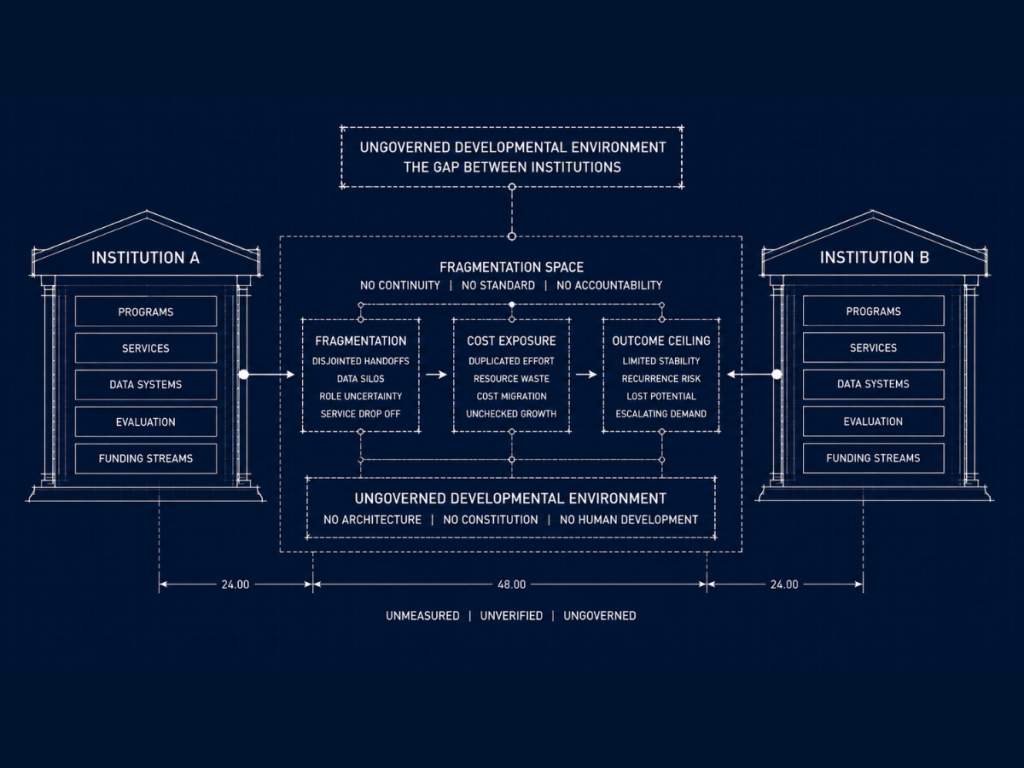
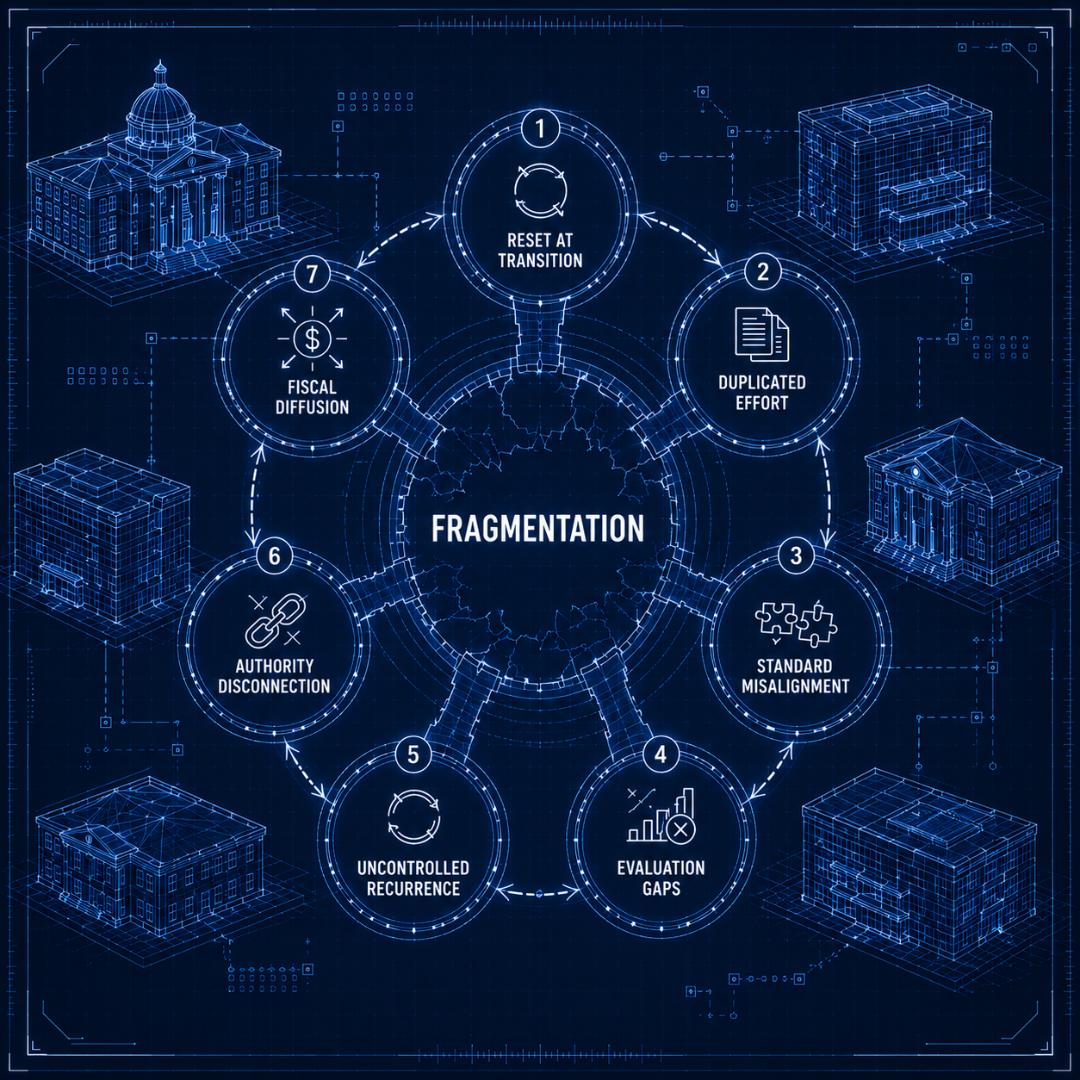
Modern cities do not suffer from a lack of programs, intervention models, agencies, or reform activity. They suffer from fragmentationa structural operating condition where systems interact with the same populations independently while instability compounds collectively across transitions, institutions, and time.

SCES identified and mapped seven recurring structural failures driving instability, recurrence, weakened prevention durability, and expanding fiscal exposure across systems:

Reset at Transition — Developmental progress weakens or disappears during institutional movement.
Duplication — Multiple systems perform overlapping stabilization activity independently.
Standard Misalignment — Agencies reinforce conflicting definitions of accountability, stabilization, and progression.
Evaluation Gaps — Cities lose longitudinal visibility into participant trajectory movement and recurrence conditions.
Uncontrolled Recurrence — Instability reorganizes repeatedly across the same populations and environments.
Authority Disconnection — Systems operate around the same populations without one governing continuity structure preserving progression collectively.
Fiscal Diffusion — Public investment disperses across fragmented intervention environments without producing cumulative stabilization.

The result is not merely inefficiency. The result is a recurring municipal condition where intervention activity expands while instability remains structurally active across the same communities, systems, and populations over time. SCES was not built to add another program inside fragmentation. It was built to govern the continuity conditions fragmentation has historically left unmanaged.

The Conditions No Program Was Designed to Govern

Cities invested continuously across prevention, supervision, workforce development, violence interruption, behavioral health, housing stabilization, and reentry systems. Many interventions produced measurable progress inside the environments where they operated. The structural condition emerged at transition.

THE SPACE BETWEEN TRANSITION

When individuals move between institutions, the continuity governing whether progress survives that movement does not transfer with them. Accountability changes. Developmental standards shift. Stabilization achieved inside one environment becomes disconnected from the next.

That space — between systems, transitions, and institutional responsibility — is where instability reorganizes faster than progression compounds.

WHY PREVENTION DOESN'T HOLD

Prevention weakens once continuity disappears across movement between systems. Developmental reinforcement fragments. Evaluation visibility disconnects. Accountability loses continuity across environments.

The outcome does not collapse because intervention lacked value. It collapses because no operating structure governed whether the outcome survived transition.

"Prevention without continuity lacks the velocity to change trajectory."

THE 1–10% POPULATION

The concentrated population repeatedly cycling through high-cost systems evolved through repeated exposure to fragmented environments where instability remained active across transitions, supervision movement, housing instability, workforce interruption, violence exposure, and disconnected developmental reinforcement.

This population represents a continuity governance condition where systems repeatedly absorb the cost of instability interrupted temporarily but never governed long enough to mature into durable stabilization.

FISCAL EXPOSURE

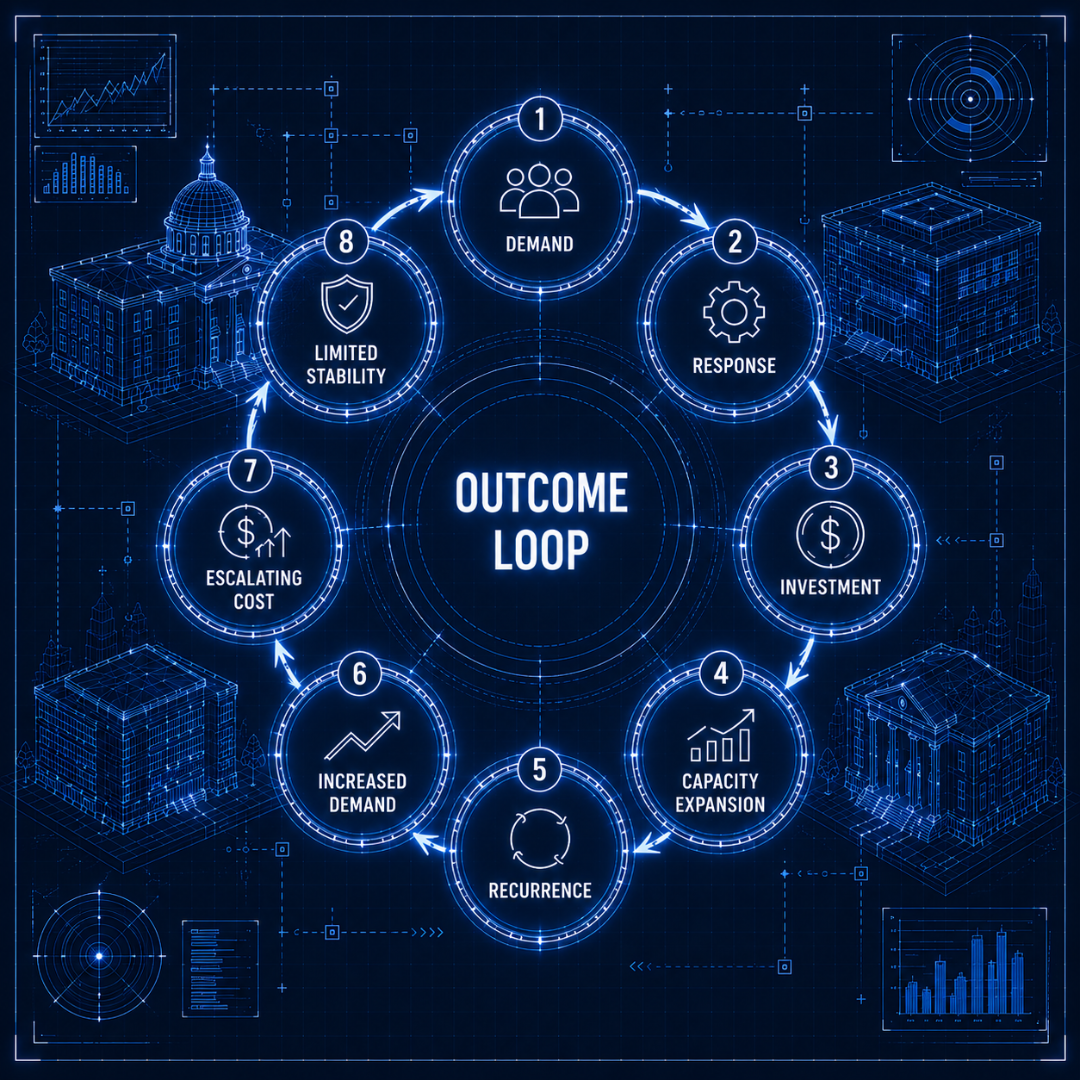
Fragmented systems do not absorb instability once. They absorb it repeatedly across public safety, shelter systems, supervision, behavioral health, workforce, crisis response, and emergency intervention environments simultaneously. 

As recurrence reorganizes across the same populations, cities continue financing disconnected stabilization activity without structurally governing whether outcomes hold long enough to reduce long-term demand.

Cost avoidance is not a projected savings figure. It is the architectural output of governed continuity.

THE GOVERNING CONCLUSION

The problem is not the absence of intervention capacity. The problem is the absence of the operating infrastructure required to preserve continuity between systems once intervention begins.

Cities built institutions to perform specialized responsibilities. What no institution was structurally designed to govern was what happens between responsibilities — where progress disconnects, recurrence regenerates, and public cost exposure compounds again.

That is the condition SCES was built to govern.

Safe Community Empowerment System

SCES is a city-licensed governance infrastructure that establishes the operating conditions under which human development, public safety operations, and cross-agency evaluation function as one continuous system — preserving progress across every institutional transition.
SCES installs as the governing layer within existing municipal authority — not above it, not in place of it. Courts retain discretion. Agencies retain jurisdiction. Providers retain specialization. What changes is the architecture that connects them — ensuring that what each institution produces is preserved, carried forward, and built upon rather than lost at the next transition period.

Once installed, SCES connects every institution the City already operates into one governed system — one standard, one data architecture, one continuity layer, one outcome.

modernization enables proactivity

Governing Public Safety With Foresight, Not Reaction

SCES gives City leadership something current systems cannot: the ability to govern public safety proactively, coherently, and defensibly across agencies and timeframes.

Rather than managing crises after they occur, leadership gains visibility into capacity development before failure, enabling earlier intervention, smarter resource allocation, and more durable outcomes without expanding enforcement or duplicating services.

Strategic Advantages for City Leadership

SCES allows Cities to govern public safety as a system—rather than manage its failures one crisis at a time.


Predictive Insight, Not Post-Event Reporting
Leadership gains real-time visibility into developmental indicators that predict violence, recidivism, and system dependency—before they manifest as arrests, hospitalizations, or violations. This allows for preventive governance rather than reactive crisis management.

Cross-Agency Coherence Without Centralization
SCES aligns agencies under shared standards and evaluation while preserving statutory authority. Agencies retain control; the City gains coordination. The result is reduced duplication, fewer handoff failures, and policy intent that translates into operational reality.

Defensible Outcomes Under Scrutiny
Evaluation is auditable, multi-level, and designed to withstand OMB, Comptroller, Council, media, and legal review. Leadership can explain what is working, what is not, and why—with evidence rather than narrative positioning.

Fiscal Discipline Through Capacity-Based Investment
Resources shift from repeated crisis response toward targeted human development that reduces long-term costs. Leadership can track whether dollars are preventing failure or merely managing it—across corrections, probation, health, and emergency systems.

Political Durability Beyond Administrations
SCES is structured to survive leadership transitions. Standards, data integrity, and licensing protect fidelity so results are not dependent on personalities or short-term priorities—allowing leadership to invest in outcomes that extend beyond a single term.

Infrastructure Designed to Govern

Five Infrastructure Walls. The Architecture that Makes Continuity Enforceable and Outcomes Governable.

Every public safety reform has added capability to the system. None has added continuity. The Governing Moat was designed to close that gap — establishing five non-negotiable infrastructure walls that govern what every other part of the system produces.

Each wall governs a specific structural failure. Each carries a governance and fiscal consequence stated below.

W1 · HUMAN DEVELOPMENT DOCTRINE
The single governing standard for what capacities must be built across every institution — eliminating competing frameworks and enforcing one shared developmental requirement across every agency, provider, and environment.

Governance: Without a shared standard, continuity is structurally impossible. Every institution defines progress differently, and progress that cannot be defined consistently cannot be preserved across transitions.

Fiscal: Standard misalignment produces reset. Reset produces repeated expenditure on the same developmental deficit. The Doctrine eliminates that deficit at the source — so the City stops paying to rebuild the same foundation across multiple institutional contacts.

W2 · EDUCATION & TRAINING DEPARTMENT
Institution-grade learning infrastructure that delivers the Doctrine through controlled curriculum, performance-based readiness standards, and sequenced advancement — producing the capacities enforcement and supervision cannot generate.

Governance: A governing standard defined but not delivered produces no change. The E&T Dept. converts doctrine into demonstrated, measurable human capacity.

Fiscal: Prepared placement holds. Unprepared placement generates re-enrollment, re-supervision, and re-crisis activation at full cost.

W3 · UNIFIED COMMUNITY DATA SYSTEM
The governed evaluation architecture maintaining system-wide visibility across all participating institutions.

Governance: Without the UCDS, leadership cannot see the system it is governing. No cross-agency view of performance, trajectory, or recurrence exists. Decisions are made on partial information and outcomes cannot be attributed to the conditions that produced them.

Fiscal: The Government Value Conversion Model operates within the UCDS. Without it, cross-agency cost cannot be aggregated, classified, or attributed. The per-individual cross-agency exposure cannot be governed without the data architecture that makes it visible.

W4 · THREE-YEAR CONTINUITY ARCHITECTURE
Structured support, evaluation, and access during the 36-month period of highest regression risk following corridor completion — protecting every prior developmental investment and ensuring outcomes compound rather than expire.

Governance: Without this wall, the governing architecture has a structural expiration date. Every component produces its value during the active corridor.

Fiscal: The highest-cost reset events occur in the 12–36 months following program completion or release. Every reset event in that window is a prior investment that did not hold — and a new cycle of expenditure that was structurally avoidable.

W5 · LICENSING & FIDELITY FRAMEWORK
The outermost wall — protecting the system from political transition, budget cycles, implementation erosion, and administrative drift. SCES is licensed infrastructure. It is embedded in the governance structure of the city, not in the priorities of any single administration.

Governance: Without this wall, every other wall is contingent on political will. The Licensing & Fidelity Framework converts SCES from an initiative into infrastructure.

Fiscal: The compounding cost avoidance SCES produces is only realized if the system operates continuously. A system discontinued after four years produces cost avoidance for four years and then restores the structural condition. This wall protects the return on every dollar invested in the entire architecture.


SCES Architectural outputs of governed continuity

The Governing Moat establishes the continuity infrastructure required to stabilize systems longitudinally. These additional architectural outputs represent the measurable operational conditions produced once fragmentation is governed, transitions are protected, and developmental continuity becomes structurally preserved across the city ecosystem.

They are not independent initiatives. They are direct outputs of governed continuity operating correctly across systems, institutions, providers, and participant movement over time.


COST AVOIDANCE

Reducing recurring expenditure through governed continuity and stabilized progression.

Reduces recurring cross-agency expenditure by preserving stabilization across transitions.
Limits high-cost system utilization by interrupting recurrence before instability reorganizes.
Converts fragmented intervention spending into cumulative long-term stabilization.
Improves the long-term return on public investment by reducing duplication, transition collapse, and recurring demand exposure across interconnected systems.


PREVENTION

Preserving prevention durability across transitions, systems, and participant movement.

Strengthens prevention durability by governing developmental progress between systems and environments.
Interrupts instability by preserving continuity across accountability, evaluation, reinforcement, and participant progression.
Reduces violence recurrence exposure by stabilizing transitions.
Aligns prevention, supervision, workforce progression, and human development under one governed continuity structure.


systemic OUTCOMEs

Producing durable stabilization across interconnected systems and institutional environments.

Produces measurable stabilization across public safety, workforce, behavioral regulation, and long-term participant independence.
Strengthens cross-agency alignment through unified developmental standards, continuity, and longitudinal evaluation visibility.
Increases contracting efficiency by reducing overlap, disconnected intervention, and inconsistent stabilization conditions.
Governs how systems function collectively around the same populations so outcomes become cumulative.

How Will We Know It's Working?

Phase I is a controlled 7-9 month build-out (depending on city scale), with a 180-day working-installation of SCES governance infrastructure across a defined cohort of 150-300 high-utilization participants. 

It is not a pilot. It is a structured validation pathway with four defined measurement outputs — each producing city-owned, independently verifiable evidence of continuity performance, recurrence reduction, and measurable cost avoidance.

Every dollar of Phase I investment is tied to a specific governing question. Every question has a specific answer date.

Four Validation Outputs. Six Months. One Decision.

VALIDATION OUTPUT ONE
DAY RANGE LABEL: Days 1–30
OUTPUT NAME: Cost Baseline Map

GOVERNING QUESTION: What is the City actually spending on this population — across every system, simultaneously?

WHAT IT PRODUCES: A verified cross-agency cost record for the Phase I cohort, drawn from existing agency data and documented through the UCDS. This is the pre-intervention baseline against which all subsequent cost avoidance is measured. For the first time, the City sees the full per-individual cost picture — not by agency, but across all of them at once.

DELIVERABLE TO THE CITY: Verified 300-participant cost baseline. Documented cross-agency expenditure map. UCDS developmental entry record for each participant.


VALIDATION OUTPUT TWO
DAY RANGE LABEL: Days 30–90
OUTPUT NAME: Reset Event Identification

GOVERNING QUESTION: Where exactly does developmental progress disappear for this population — and is SCES continuity stopping it?

WHAT IT PRODUCES: A documented map of the specific institutional transition points where recurrence has historically originated for the Phase I cohort. Simultaneously, SCES continuity governance is fully activated — corridor enrollment, IEP initialization, Performance Coach relationships, AAVIT routing. Early UCDS data begins showing whether continuity is holding at the transition points that historically produced reset.

DELIVERABLE TO THE CITY: Reset pathway map. Transition point documentation. First 30–60 days of continuity performance data. Early progression indicators across the five Doctrine capacity domains.


VALIDATION OUTPUT THREE
DAY RANGE LABEL: Days 60–120
OUTPUT NAME: Demand Trajectory Readout

GOVERNING QUESTION: Is SCES producing measurable developmental trajectory change — and are recurrence indicators declining?

WHAT IT PRODUCES: The first validated comparison between the cohort's current developmental trajectory and the Day 1 baseline. UCDS data is now sufficiently populated to show capacity advancement across emotional regulation, decision-making, behavioral accountability, interpersonal functioning, and economic mobility. Early recurrence comparison data shows whether governed participants are re-entering systems at lower rates than their own historical patterns.

DELIVERABLE TO THE CITY: Validated trajectory comparison against Day 1 baseline. Capacity domain advancement documentation. Early recurrence rate comparison. Continuity survival data at institutional transition points.


VALIDATION OUTPUT FOUR
DAY RANGE LABEL: Days 90–180
OUTPUT NAME: Cost Migration Signal

GOVERNING QUESTION: Is governed continuity producing measurable reductions in cross-agency cost exposure — and what does the City's return look like?

WHAT IT PRODUCES: The Government Value Conversion Model captures and converts reductions in system re-engagement into documented cost avoidance figures — attributed by system, by agency, and by specific continuity intervention. Reductions in correctional re-entry, shelter cycling, supervision violations, crisis response utilization, and emergency contacts are tracked, verified, and converted into a City-owned cost avoidance record.

DELIVERABLE TO THE CITY: GVCM cost avoidance output. Agency-level recurrence reduction documentation. Phase I Validation Report — the complete 180-day evidence record delivered to the Office of the Mayor as the basis for the Phase II expansion decision.

City Size & Scale

Large scale cities (NYC example) currently spends between $195,000 and $325,000 per individual per 18 months across the combined agency systems serving this population. 

Across 300 participants, that is between $58.5 million and $97.5 million in existing cross-agency expenditure — already recurring, already compounding, currently ungoverned.

Phase I investment: $69,000,000.

Projected cost avoidance across 300 participants: $21 million to $45 million within the first 18 months of governed operation.

Phase I does not add to the City's cost exposure. It replaces a portion of uncontrolled recurring expenditure with a governed, measurable, city-verified investment that produces documented returns.

DISCLAIMER: Directional estimates derived from observed NYC agency cost structures. Not audited per-capita allocations. Validated through UCDS cost tracking beginning in Phase I.

The Decision Point

At Day 180, the City owns the evidence. The Phase I Validation Report documents developmental progression, recurrence reduction, continuity performance, and cost avoidance across 300 participants — independently verifiable, available to agency heads, oversight bodies, and city leadership.

Phase I ends with one question: does the evidence support expansion?
It is designed to.

Does your city have a fragmentation problem?

 Complete the 6-question assessment that identifies your city's fragmentation profile. Takes 2 minutes. No contact information required.

Your responses are not scored or shared. This assessment is designed to help you identify your city's specific fragmentation pattern — nothing else.

Data Integrity, Authority Boundaries & Public Trust

Evaluation Without Surveillance

SCES does not monitor people for enforcement purposes. It evaluates developmental progress to determine whether capacity is being built, support is effective, and public investment is producing real safety outcomes. 

The system is designed to answer one question only: 
Is human capacity strengthening over time?

It does not track location, associations, or behavior for punitive use. It does not predict criminal activity. It does not automate sanctions. It replaces fragmented, duplicative reporting with a governed, ethical evaluation framework focused on development—not control.

Purpose-Bound Data Architecture
All data within SCES is governed by strict purpose limitation. Information exists solely to support:

Human development evaluation
Service coordination
System performance accountability

Data cannot be repurposed for enforcement, investigation, or generalized surveillance—technically or procedurally. If a data element does not serve a defined developmental or evaluative purpose, it does not exist in the system.

This architecture prevents mission creep by design, not by promise.

Role-Based Access & Auditability
Access is determined by function, not authority.

- A facilitator sees educational performance—not clinical records.


- A coach sees developmental indicators—not full histories.


- An employer sees readiness—not justice involvement.

Every access is logged. Every change is traceable. Every use is auditable. SCES's Unified Community Data System (UCDS) generates an enforceable Data Truth Chain of accountability for information use that protects participants, agencies, and the City itself.

Human Judgment, Always.

SCES does not automate decisions. The system may surface patterns. It cannot impose consequences.
 All determinations affecting participants require human review, professional judgment, and documented rationale. This preserves due process, prevents algorithmic punishment, and ensures that development—not detection—governs response.

Legal & Governance Safeguards
SCES is structured to operate within municipal authority, not around it.

No expansion of enforcement power
No delegation of judicial or supervisory authority
No circumvention of privacy law

The system aligns with existing legal frameworks governing health, education, and justice data, while resolving ambiguity through clearer role boundaries rather than broader access.

Data retention is limited. Records are sealed when no longer necessary. Participants retain transparency into what exists, who accesses it, and why.

Legally, SCES reduces institutional exposure by:
- Eliminating informal data sharing
- Replacing discretionary judgment with documented standards
- Creating defensible audit trails for every decision

This is not risk creation. It is risk containment through integrity.

Why This Matters for Cities? Because Public Trust is Infrastructure. 

SCES enables the City to modernize public safety without expanding surveillance, compromising civil liberties, or creating political vulnerability. It allows leadership to govern using evidence that can withstand legal scrutiny, public inquiry, and ethical review.

The result is a system that is:
- Trusted by participants
- Defensible to oversight bodies
- Safe for agencies to operate
- Credible to the public

This is how modernization becomes authorizable.