ONE CITY. ONE SYSTEM. ONE STANDARD.

Cities Do Not Fail From Lack Of Effort.
They Fail From Lack Of Structure.

city systems function as designed

The Evolution of a Municipal Condition

Public safety and human service ecosystems did not fail by accident. They were built deliberately — agency by agency, mandate by mandate, over decades — in direct response to crime, housing collapse, incarceration, economic disconnection, and recurring community crisis. Each institution was designed to govern a specific problem inside a specific boundary.

The architecture made sense when problems were discrete. They are no longer discrete.

The populations generating the highest demand across municipal systems are not experiencing one problem inside one agency. They are experiencing the same interconnected instability condition across corrections, shelter, behavioral health, supervision, workforce, and crisis response simultaneously. The systems governing them were never designed to operate as one. They still do not.

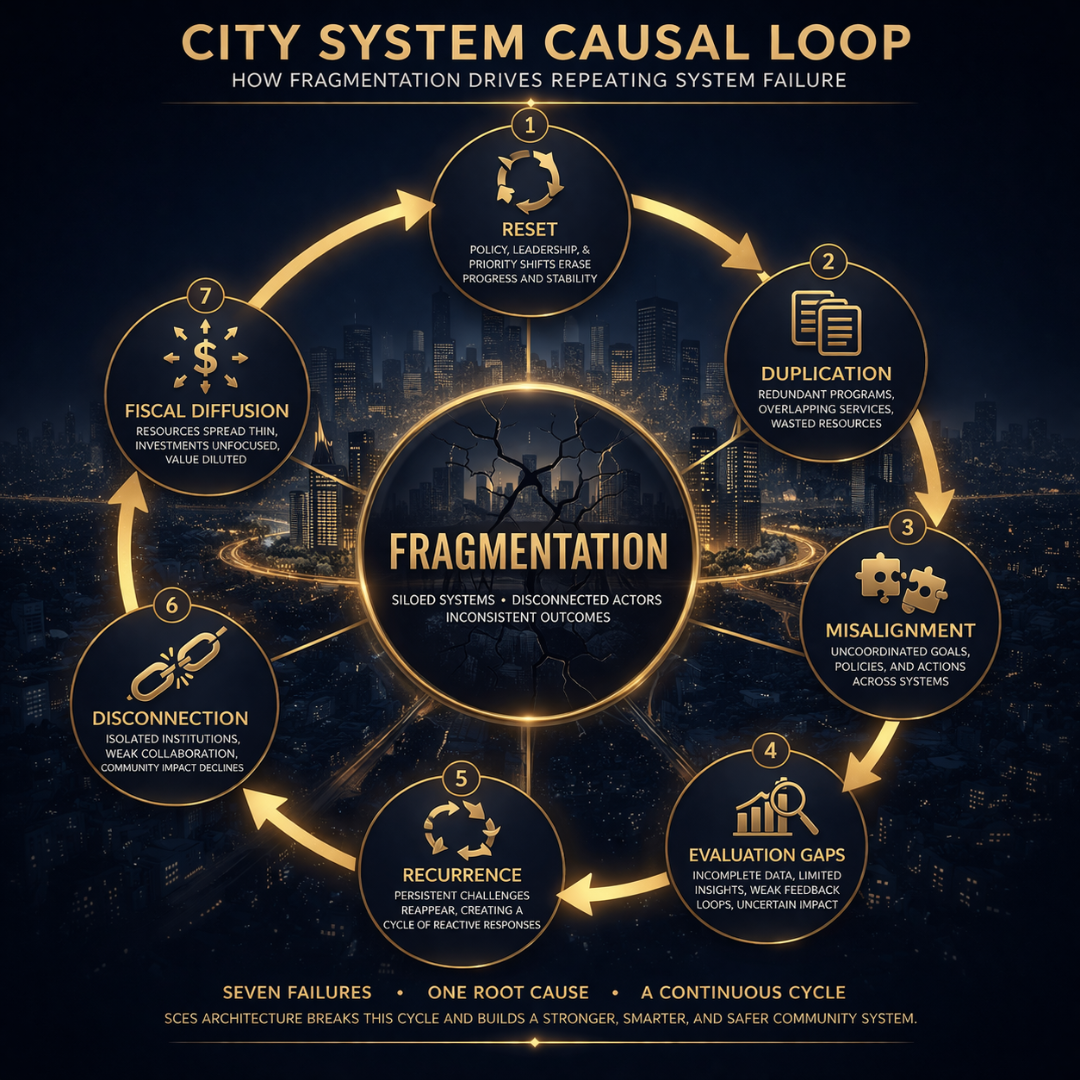
Fragmentation is the result — not of poor design within any institution, but of the absence of a governing architecture connecting them. And fragmentation produces a condition that compounds:

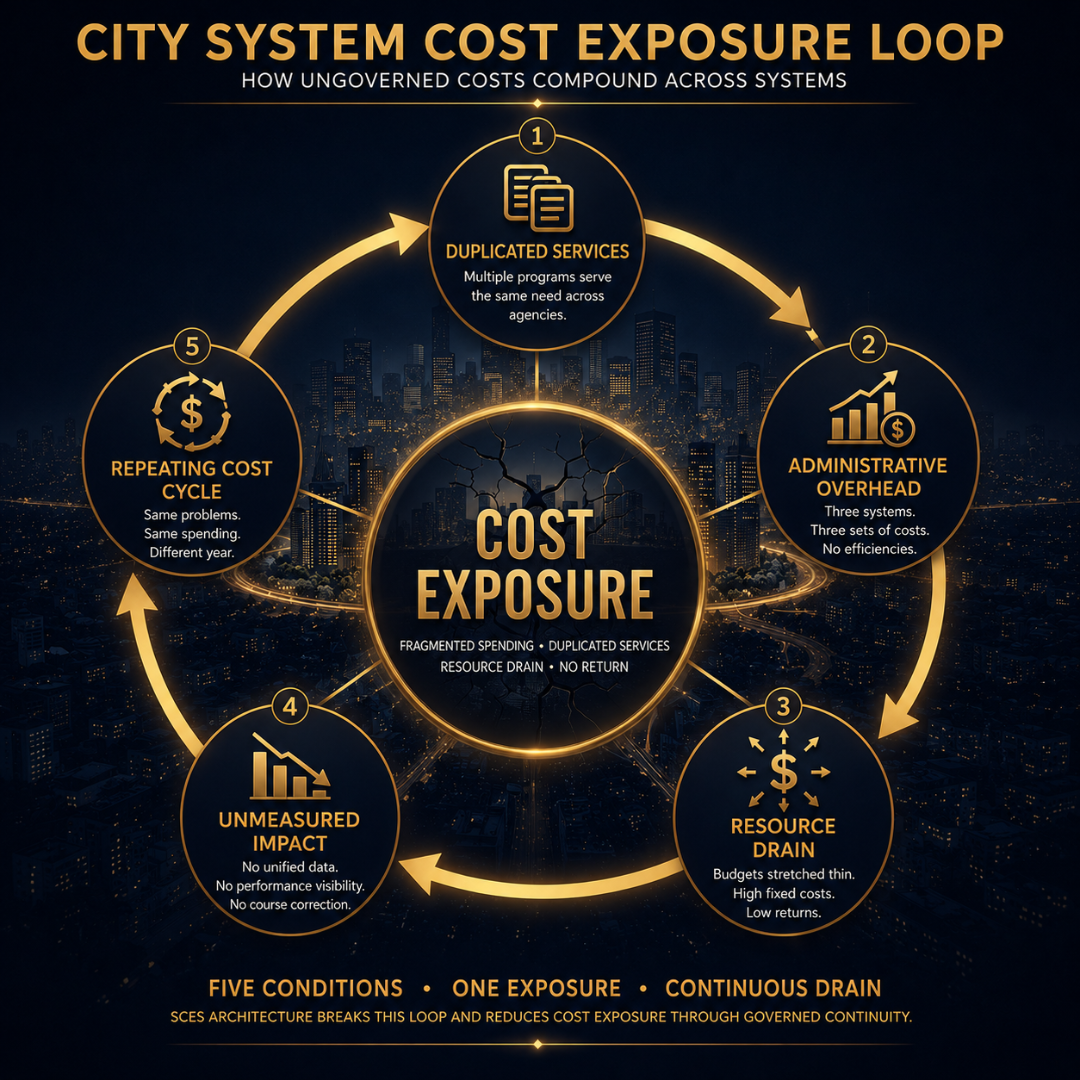
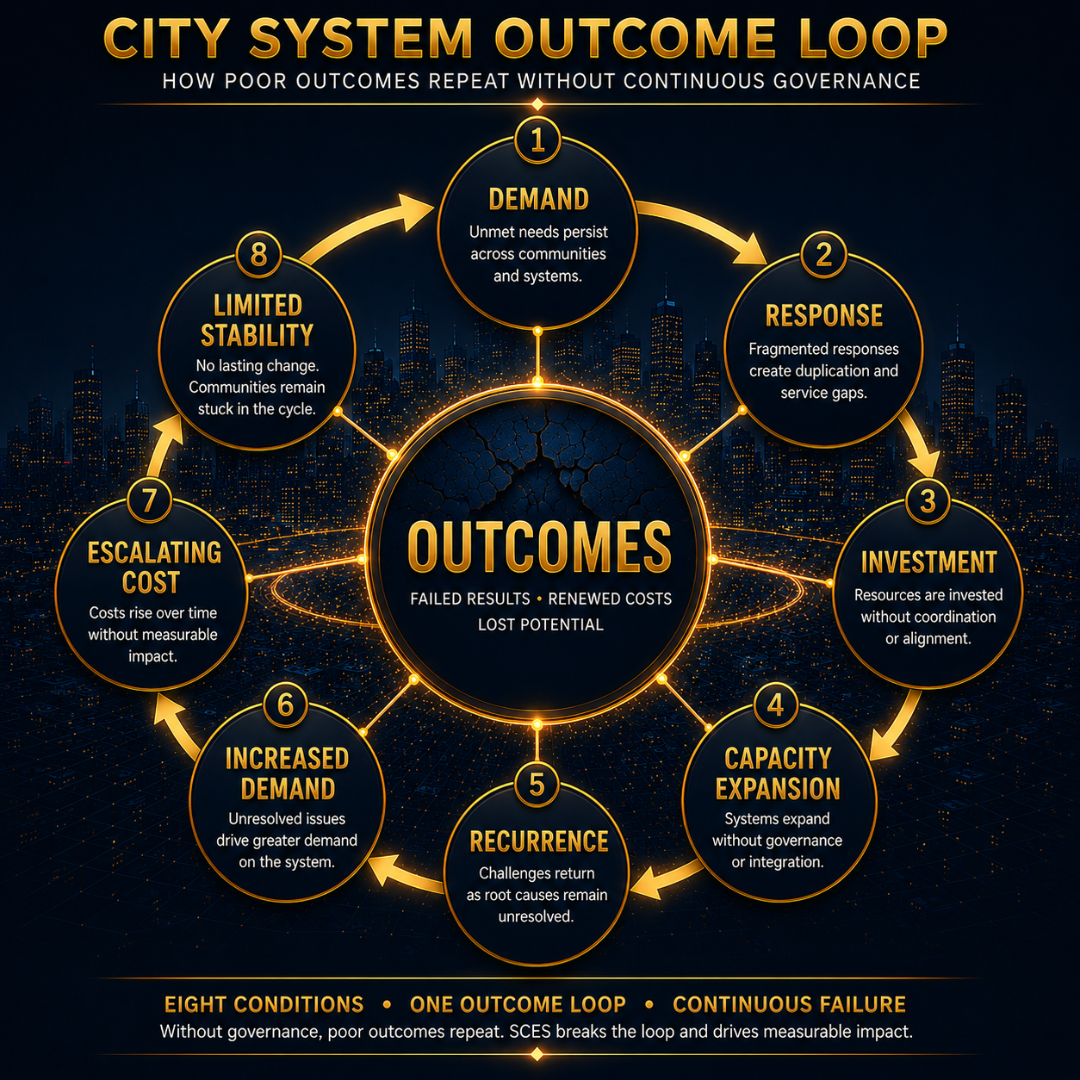
Weak continuity generates recurring demand. Recurring demand increases cross-agency cost exposure. Cost exposure compounds without unified fiscal governance. Outcomes remain episodic rather than cumulative. The same population cycles. The same cost migrates. The same communities absorb it.

That is not a reform problem. It is an architectural one. And it requires an architectural response.

how the system works

Phase I — Operational Calibration & Continuity Installation

New York City operates at approximately 8.3 million residents across the most operationally complex municipal ecosystem in the country. Albany operates at approximately 100,000. Between them sits nearly every municipal operating condition in America.

SCES uses New York City as the highest-scale installation model — engineering, stress-testing, and validating governed continuity against the most demanding operational environment available. The complexity varies by city. The underlying condition does not.

Every municipal system faces the same defining test: whether a concentrated population repeatedly cycles through public safety, supervision, shelter, behavioral health, workforce, and crisis response over time. When recurring utilization concentrates inside a small percentage of the population, fragmentation exists operationally — regardless of city size, geography, or intervention strategy.

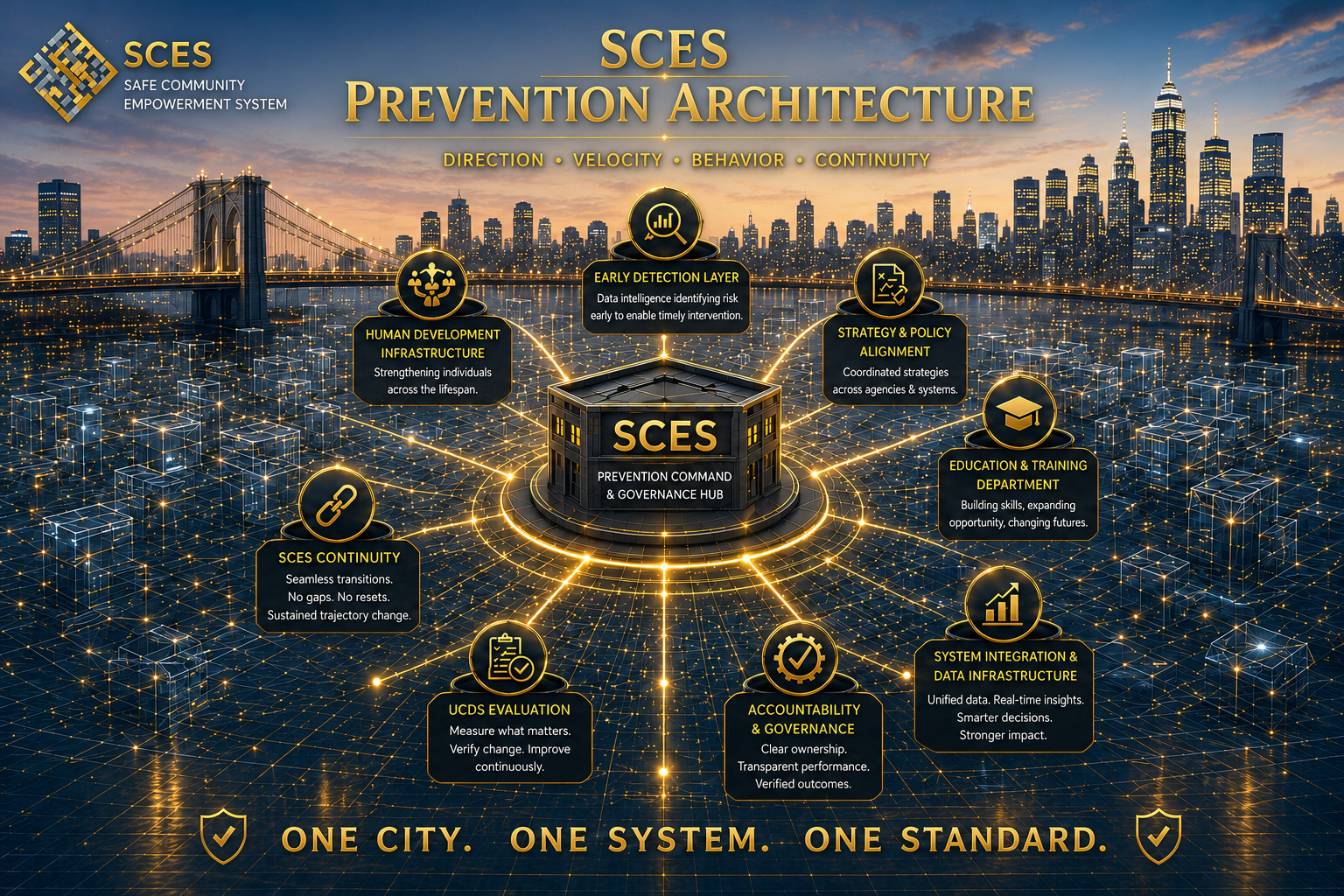
SCES Phase I Installation maps the actual operating condition of the city before a single component is installed. Agency structures, departmental responsibilities, population patterns, contracted provider ecosystems, continuity gaps, and recurring demand pathways are documented against operational reality — not a theoretical model. Installation is calibrated to what the city actually operates, not what its organizational chart describes.

Nothing is displaced. Nothing is disrupted. The governing continuity structure is installed across what already exists — so that what already exists begins performing as one system.

the governing moat

governing operational Infrastructure

The Governing Moat - Five Walls. One Standard. No Reset.

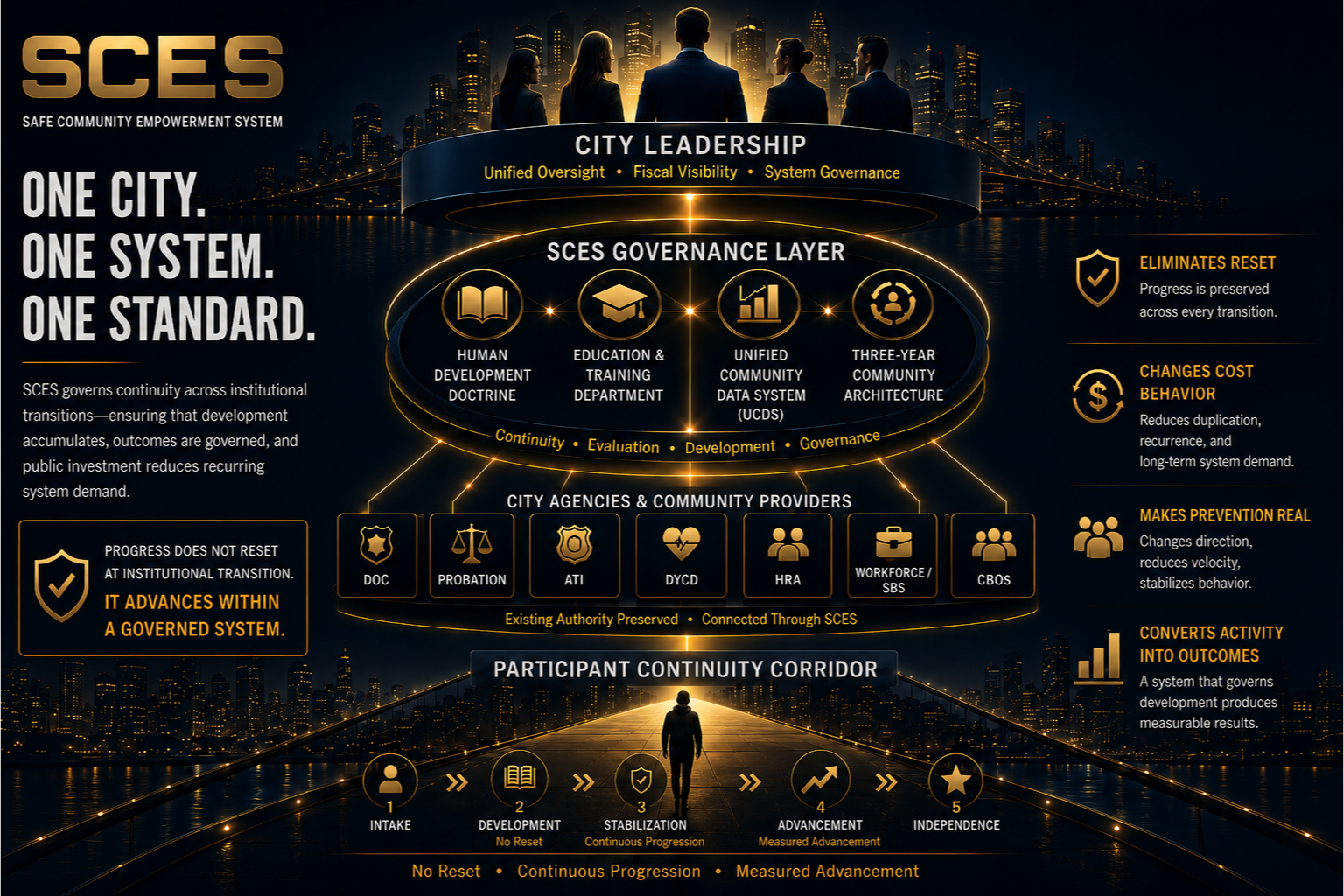
The Governing Moat was introduced on the home page as the architecture that governs what the city's existing ecosystem produces. This section is not a restatement of that architecture. It is the account of how it installs — how each wall connects to the others, how all five operate as one governing condition across agencies, providers, and institutional environments simultaneously, and what the municipal ecosystem looks like once the architecture is live.

What the home page defined, this page makes operational.

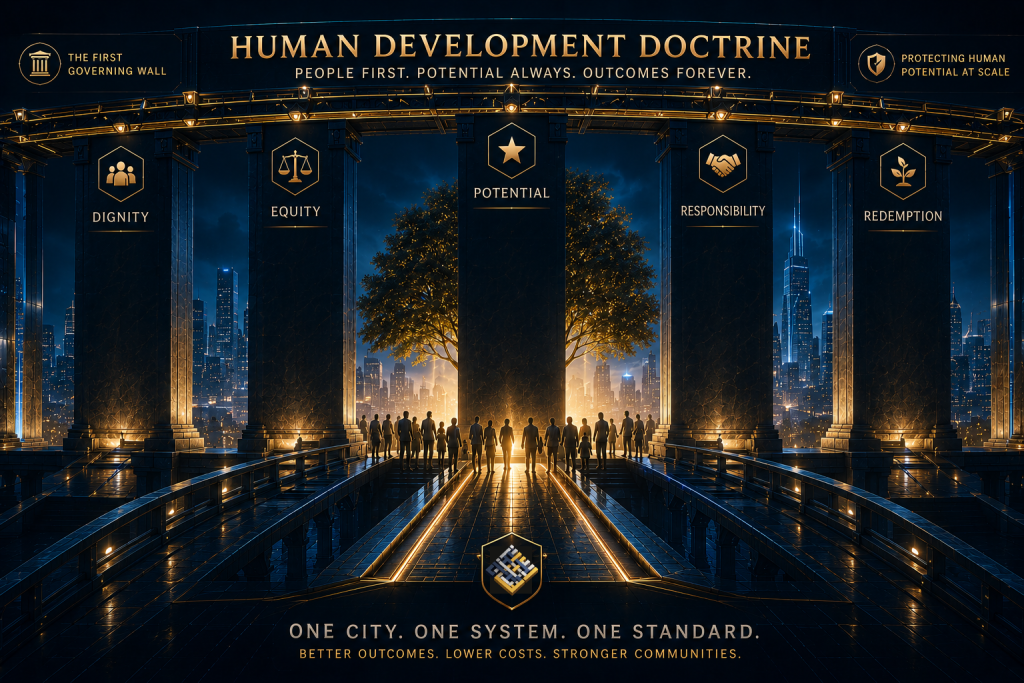
W1 — Human Development Doctrine 
One governing developmental standard applied across every participating agency, provider, and institutional environment. Not a curriculum. Not a framework to be adapted locally. A fixed standard governing what development must produce — at what threshold — before advancement is permitted at any transition point in the system. Every institution recognizes the same definition of readiness. Every transition preserves rather than erases what was built.
W2 — Education & Training Department 
Institution-grade developmental infrastructure installed across three simultaneous tracks: Participant Development delivering Doctrine-aligned capacity construction across the full corridor; Agency and Administrator Certification governing authorized system operation at every institutional level; and CBO and Partner Professional Development aligning community ecosystems to the same standard under a governed certification framework. Every person operating within SCES does so under a defined certification tier. The standard does not vary by provider.
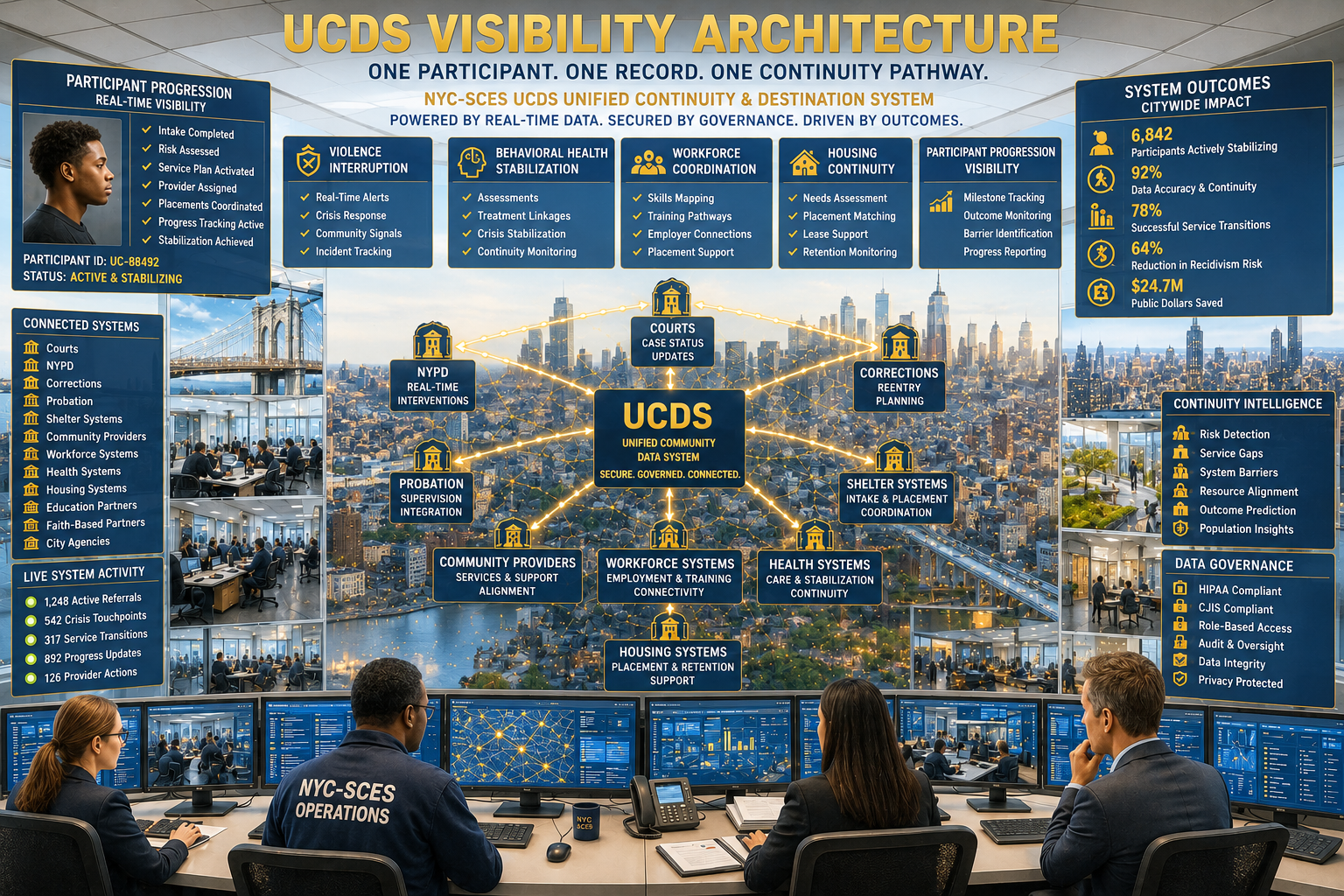
W3 — Unified Community Data System (UCDS) 
Four core components governing evaluation continuity across the ecosystem. The Developmental Record is the longitudinal participant file — populated from Day 1, never reset. The Data Truth Chain governs how data is entered, accessed, and used — every entry logged, attributable, and purpose-limited. The Recurrence Monitoring Layer tracks behavioral preconditions across the population in real time. The Government Value Conversion Model translates recurrence reductions into documented, agency-attributed cost avoidance. The City sees its system performing. For the first time.
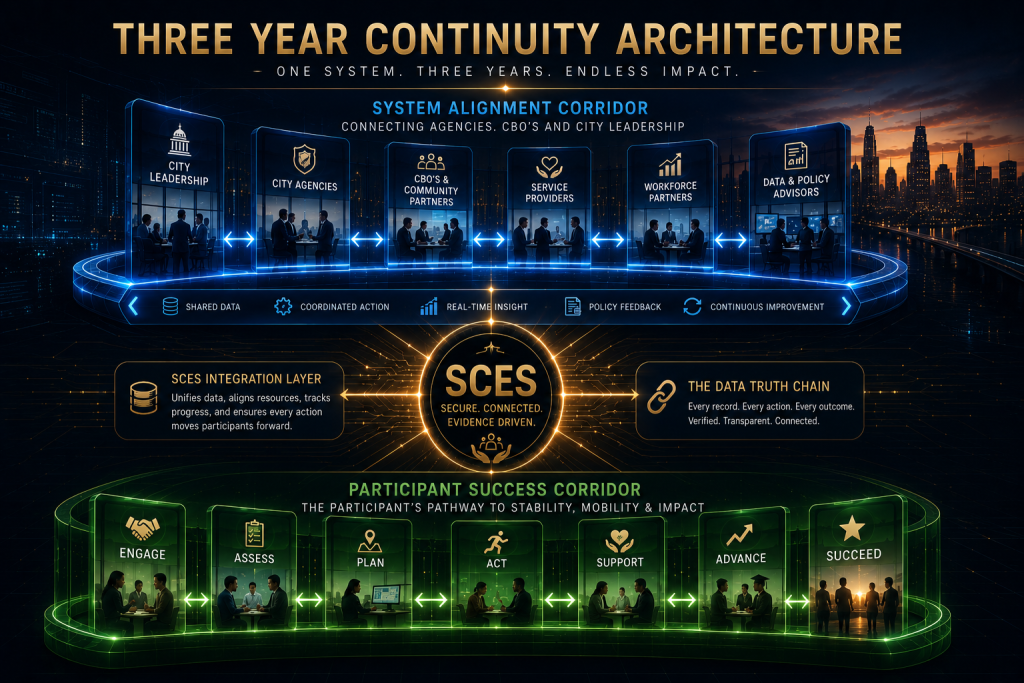
W4 — Three-Year Continuity Architecture 
Five governed corridor stages preserving developmental progression across the full arc: Intake and Orientation establishes the baseline. Core Development builds the Doctrine-required capacity. Stabilization reinforces development across real environments. Advancement activates economic mobility and independence pathways. Continuity and Independence sustains the development across the highest-risk regression period — governed by Warm Handoff Protocol at every institutional transition, until the evidence supports exit. Not the calendar.
W5 — Licensing and Fidelity Framework 
Four protection conditions operating simultaneously: Drift Prevention ensures the standard does not shift with leadership or budget cycles. Certification Continuity makes authorized operation a renewable governed credential. Fidelity Auditing produces documented compliance records available to city oversight at any point. Administration Survivability converts SCES from an initiative into infrastructure — embedded in the city's governance structure, outlasting every administration that authorizes it.

Five walls. Interdependent. Remove one and the system loses its capacity to govern the condition the others were built to protect.

the governed stability loop

Bringing Stability Under Governance

Fragmented systems do not fail because interventions lack value. They fail because no governing structure connects those interventions into a sequence capable of producing cumulative outcomes. 

Each system performs its function. Nothing governs what the sequence produces collectively.

The Governed Stability Loop is that governing sequence.

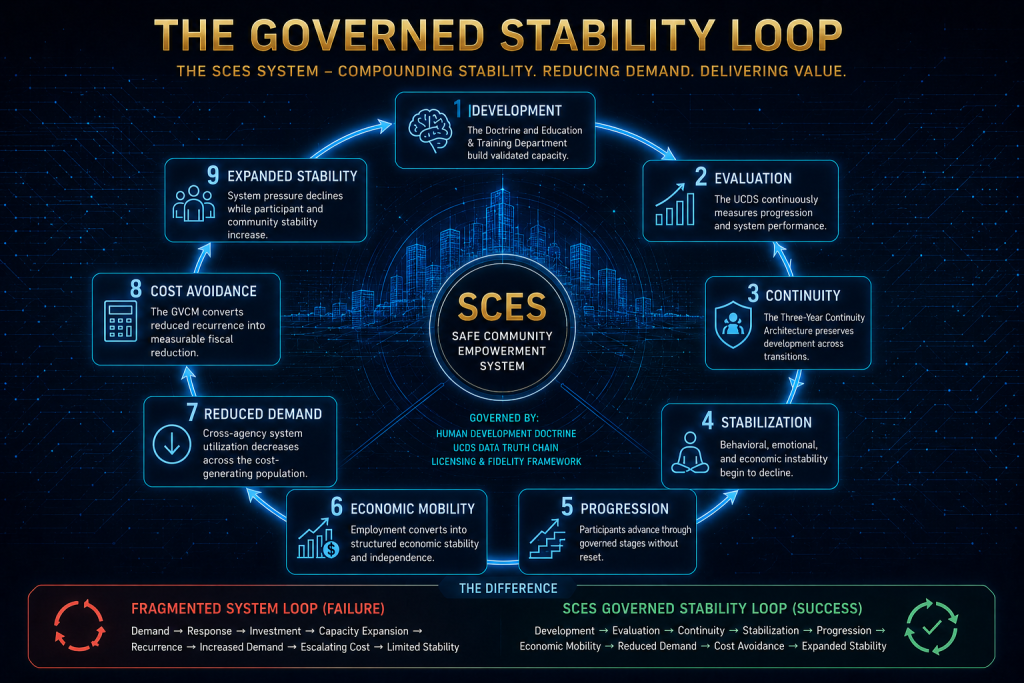
It is not a theory of change. It is the operational logic of what SCES installs — nine sequential stages through which governed continuity converts fragmented intervention activity into cumulative public safety, economic stability, and measurable cost avoidance across the municipal ecosystem.

The Loop is activated by the Governing Moat. It is sustained by the Three-Year Continuity Architecture. Once installed, it replaces the condition the city has been financing — where demand generates response, response generates investment, investment generates activity, and activity generates more demand — with a governed sequence where each stage compounds the one before it.

Development produces validated capacity. Evaluation preserves and measures it. Continuity carries it across transitions. Stabilization holds it across environments. Progression advances it toward independence. Economic Mobility makes independence structurally possible. Reduced Demand documents the population-level result. Cost Avoidance converts that result into verified fiscal performance. Expanded Stability compounds outward — from the governed individual into the household, the family, the neighborhood, the community.

The fragmented system compounds recurrence. The Governed Stability Loop compounds stability.

Those are not variations of the same outcome. They are opposite operating conditions — and SCES installs the one the city has never had.

EDUCATION - CONTINUITY - PREVENTION

The System Driver Profile

Prevention without Continuity Lacks The Velocity To Change Trajectory.

Every city serves System Participants. Every city also contains System Drivers.

System Participants interact with municipal systems through normal, episodic, or intended utilization. They access services, use public resources, engage institutions as designed. They do not generate disproportionate recurring demand across multiple systems over time.

System Drivers represent a concentrated population whose instability conditions generate disproportionate demand, utilization, and cost exposure across multiple municipal systems simultaneously. Their interaction is not defined by one agency, one event, or one service — but by recurring movement across the ecosystem at the highest cost to public safety, crisis response, and public investment. 

Justice involvement that recurred across supervision levels without a governing developmental structure preserving progress between contacts. Housing instability that tracked alongside justice involvement without a continuity pathway connecting stabilization across transitions.

Workforce disengagement that reflected not a lack of opportunity but the absence of the developed capacity — emotional regulation, behavioral accountability, economic functioning — required to sustain employment under real-environment pressure. Violence exposure that produced crisis response contacts without a governed developmental pathway converting those contacts into sustained stabilization.

The System Driver condition is not evidence of individual failure. It is evidence of a governing deficit — recurring instability conditions remaining active because no architecture was ever installed to govern their developmental arc longitudinally across the systems they moved through.

That is what the Continuity Corridor governs. Not the symptom at the most recent system contact. The full developmental arc producing the pattern.

The Education & Training Department

Institution Grade Development

Not Instruction. Not Services. Not Case Management.

The Education and Training Department is not comparable to any education or training model currently operating inside New York City's public safety or human services ecosystem. That is not a positioning claim. It is an architectural distinction.

Every program in the current ecosystem delivers content. The E&T Department governs whether content becomes demonstrated human capacity — and whether that capacity survives the next institutional transition. 

No program currently operating is designed to do both simultaneously under a continuous governed evaluation standard that travels with the participant across every system they move through.

It constructs capacity against the governing standard. It operates within a structured full-day environment — not sessions, not appointments, not groups — with continuous behavioral observation, UCDS documentation, and Performance Coach supervision active simultaneously.

Development is not inferred from attendance. It is observed, recorded, and validated before advancement is authorized.

The five Doctrine domains — Emotional Regulation, Decision-Making Architecture, Behavioral Accountability, Interpersonal Functioning, and Economic and Financial Mobility — each carry a defined threshold, a measurable indicator, and a documented advancement criterion. Advancement is earned through validated capacity. The system accommodates pace. It does not compromise standard.

For participants presenting with active anger, aggression, and violence pathways, AAVIT I and II operate as embedded intervention tracks — not external referrals, not parallel programs. Cognitive behavioral intervention, trauma-informed practice, cognitive restructuring, and validated risk-needs-responsivity assessment. Inside the corridor. Development continues without interruption.

The transition from System Driver to System Participant is not a program outcome. It is a governed developmental achievement. The Education & Training Department is where that achievement begins.

The participant continuity corridor

The Governed Arc from System Driver
to System Participant

The Continuity Corridor is the governed developmental pathway through which the Doctrine becomes the participant's demonstrated, preserved, and sustained reality. It does not operate on a program calendar. It does not close when a funding period ends. It does not restart when an institutional transition occurs.

It advancescontinuously, across every environment the participant moves through, from entry to independence — governed by demonstrated capacity at every stage.

Stage One — Intake and Orientation establishes the full developmental baseline across all five Doctrine domains. The IEP is initialized. The Performance Coach relationship is activated. Evaluation begins at Day 1 and does not reset.

Stage Two — Core Development delivers mandatory foundational curriculum across all five domains simultaneously inside the structured full-day E&T environment. No calendar governs advancement. Validated capacity does. AAVIT I is administered for participants with active aggression pathways.

Stage Three — Stabilization tests whether development holds outside the most controlled environment the system provides. UCDS evaluation remains continuous. Warm 

Handoff Protocol governs every institutional transition. AAVIT II is administered where indicated. The Performance Coach is the primary continuity mechanism across every environment the participant moves through during this stage.

Stage Four — Advancement activates workforce development, financial mobility, and leadership tracks. Institutional dependency begins to reduce. The IEP expands to reflect advancing developmental targets. Risk indicators remain actively monitored through UCDS data.

Stage Five — Continuity and Independence is governed by the Three-Year Continuity Architecture. Support reduces in proportion to demonstrated trajectory stability — governed by UCDS data, not elapsed time. Exit from active SCES governance is a data-supported determination. Not an administrative decision.

The participant who exits Stage Five is not a program graduate. They are a System Participant — operating within the municipal ecosystem without generating disproportionate recurring demand. That transition is what the Corridor was built to produce. That is what no program, no case management model, and no wraparound arrangement is structurally designed to govern.

prevention architecture

What Prevention Requires — And Why Continuity Is Its Only Delivery Mechanism

What is currently classified as prevention is not prevention.

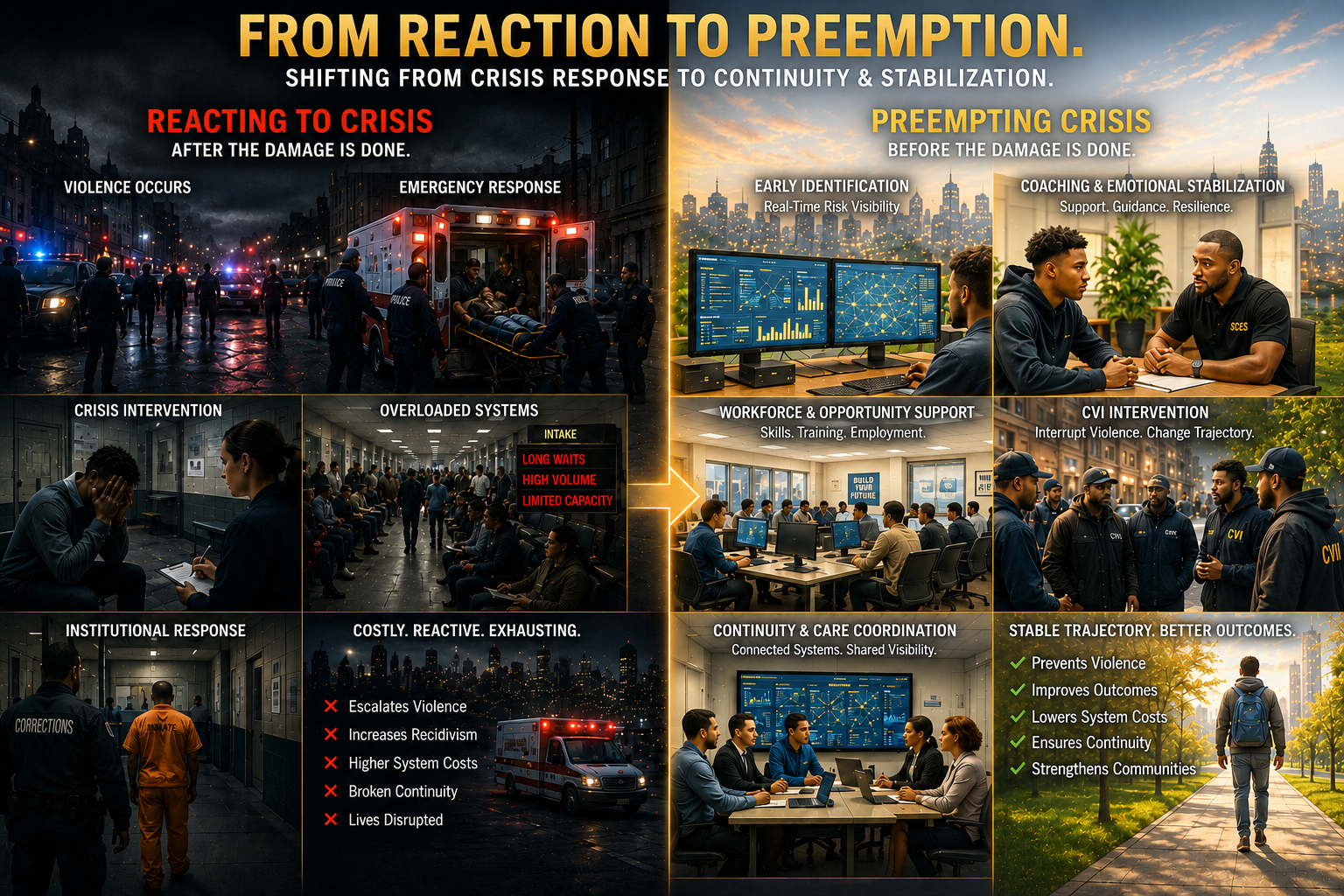
It is interruption. It is crisis management. It is risk reduction deployed at the point of elevated danger. These functions have real value. Calling them prevention misclassifies what they do, overstates what they produce, and allows cities to believe the prevention infrastructure exists when it does not.

Interruption stops an event. It does not govern the developmental conditions that make the event likely. Crisis management stabilizes an acute condition. It does not govern the trajectory producing the next one. If the risk is visible and present, the window for prevention has already closed. What is operating at that moment is response — necessary, sometimes life-saving — but response.

Prevention is the condition that makes response unnecessary. It is the architectural output of governing human development before the inflection point arrives — building the internal capacities that make violence an avoidable choice rather than a functional response to unresolved conditions.

That requires development. Development requires continuity. Continuity requires architecture.

Violence interruption models are deployed at the point of crisis. They are not designed for the three-year developmental arc that follows. The relationship a CVI worker builds during an interruption is real. Without a governing architecture to receive that individual and advance their 

development forward, the relationship produces a stabilized moment — not a changed trajectory.

SCES does not replace violence interruption. It provides the architecture that makes interruption produce something that holds.

Prevention inside SCES is not a program track. It is a property of the architecture — operating across five embedded mechanisms simultaneously.

The Human Development Doctrine builds emotional regulation, decision-making architecture, and behavioral accountability across the System Driver population. Not situationally. Structurally — validated, documented, and preserved across every environment that population moves through.

AAVIT I and II address active violence pathways inside the governed corridor before they produce community-level events. Operating on the behavioral and cognitive architecture beneath the risk. Prevention at the level of cause — not consequence.

The UCDS Recurrence Monitoring Layer tracks the preconditions of violence in real time — escalating conflict patterns, declining regulation scores, social network destabilization, disengagement from structured environments. The system governs the precondition. Not the incident.

Performance Coaching maintains governed developmental relationships throughout the Corridor — recognizing pre-crisis behavioral signatures and activating stabilization inside the system before those signatures become community events.

The Three-Year Continuity Architecture governs the highest-risk period for violence involvement — the eighteen to thirty-six months following initial stabilization. That is the period every current model abandons. SCES governs it specifically because that is where developmental regression and violence re-involvement most commonly originate when architecture is absent.

Prevention without continuity lacks the velocity to change trajectory. The Three-Year Architecture is the continuity. It is what gives prevention its velocity.

three-year continuity architecture

governing the Period Every Other
Model Abandons

The Highest-Risk Window Is Not at Entry. It Is After Stabilization Ends.

The most consistent finding across reentry research, behavioral health continuity studies, and criminal justice outcome evaluations is not that interventions fail during engagement. It is that outcomes fail after engagement ends — specifically, in the eighteen to thirty-six months following initial stabilization.

That is when housing instability resurfaces. Employment is lost. Behavioral health supports disengage. Peer networks reconnect. Financial pressure compounds. The developmental gains made during the intervention period are tested by precisely the conditions that produced the instability in the first place — and without a governing continuity structure, those gains fail the test at a rate the current system has never been designed to measure, let alone govern.

Every program in New York City's current ecosystem ends before this period arrives. Not because programs are poorly designed. Because programs are funded, contracted, and evaluated against the acute intervention period — not against the developmental arc required to produce stability that holds.

The Three-Year Continuity Architecture is not an extension of the program. It is the governing structure that takes over precisely where every program stops — and maintains calibrated, governed developmental engagement across the full period of highest regression risk.

It operates through four mechanisms operating simultaneously.

1- Calibrated Coaching Intensity maintains the Performance Coach relationship across the full three-year period. Support does not disappear after stabilization. It reduces in proportion to demonstrated trajectory stability — documented through UCDS data, not assumed by calendar. The participant's engagement level reflects their actual developmental position at every point across the three years.

2- Ongoing UCDS Evaluation ensures that progression is never unmonitored between formal engagements. Behavioral indicators, workforce engagement, housing stability, coaching observations, and peer network data continuously populate the participant's developmental record. Early warning indicators trigger response before regression becomes crisis. The City sees the trajectory moving — or not moving — in real time.

3- Warm Handoff Protocol governs every institutional transition within the three-year period. Every transition — from corrections to supervision, supervision to housing, housing to workforce, any environment to the next — is preceded by a documented UCDS transition record, a structured verbal briefing between sending and receiving institutions, and a Performance Coach connection established within seventy-two hours of arrival. The participant does not experience a developmental break.

The Individual Empowerment Plans (IEP) does not restart. The record travels.

4- Economic Mobility Advancement ensures the three-year period does not maintain stabilization — it advances toward independence. Credit building. Asset development. Career pathway progression. Benefit navigation. Entrepreneurial development where applicable. The corridor does not end at stability. It ends at the demonstrated capacity for sustained, lawful, independent economic participation — the structural condition under which every other Doctrine domain holds over time.

The Three-Year Architecture is the difference between an outcome that holds and an outcome that expires. It is the mechanism that protects every prior investment made across the corridor — and the reason SCES produces cost avoidance that compounds rather than cost reduction that reverses.

One city. one system. one standard.

What SCES Governs & Why Nothing Else Does

New York City has programs. It has providers. It has agencies, contracts, community relationships, intervention systems, and billions of dollars in annual public investment directed at the conditions SCES was designed to govern.

None of it is the same thing.

Programs deliver content within defined operational boundaries. SCES governs whether content becomes demonstrated capacity. Agencies serve populations within jurisdictional mandates. 

SCES governs whether what agencies produce is preserved when those populations move. Wraparound services coordinate access across providers. 

SCES governs whether that access produces development that survives the next transition. Violence interruption stops specific events at specific moments. 

SCES governs the developmental conditions that determine whether the next event occurs.

The distinction in every case is the same. Programs govern episodes. SCES governs trajectory. And trajectory — not program contact, not service delivery, not supervision compliance — is what determines whether a System Driver becomes a System Participant, whether a community accumulates stability or recurrence, and whether a city's public investment compounds into durable outcomes or finances the same condition in perpetuity.

SCES was not built to compete with any of these systems. It was built to govern the condition none of them was designed to govern — the developmental and continuity arc that determines what every other investment in the ecosystem ultimately produces.

The Governing Moat installs the standard. The Education & Training Department constructs the capacity. The Corridor governs the journey. The Three-Year Architecture sustains what the journey builds. The Prevention Architecture ensures the architecture operates upstream of the crisis rather than downstream of it. The Governed Stability Loop converts all of it into cumulative, measurable, city-owned evidence of what governed continuity produces.

This is infrastructure. It is designed to perform across administrations, budget cycles, political transitions, and provider turnover. It is designed to outlast every condition that has ended every prior model. It is designed to be the last governance layer the city installs for this population — because it is the first one designed to actually hold.

Every city already knows who its System Drivers are. What no city has installed is the governing architecture that changes what they become.

SCES installs that architecture. Built to last. Built to govern. Built to produce the outcome cities have been funding toward without the infrastructure to reach.

One City. One System. One Standard.